
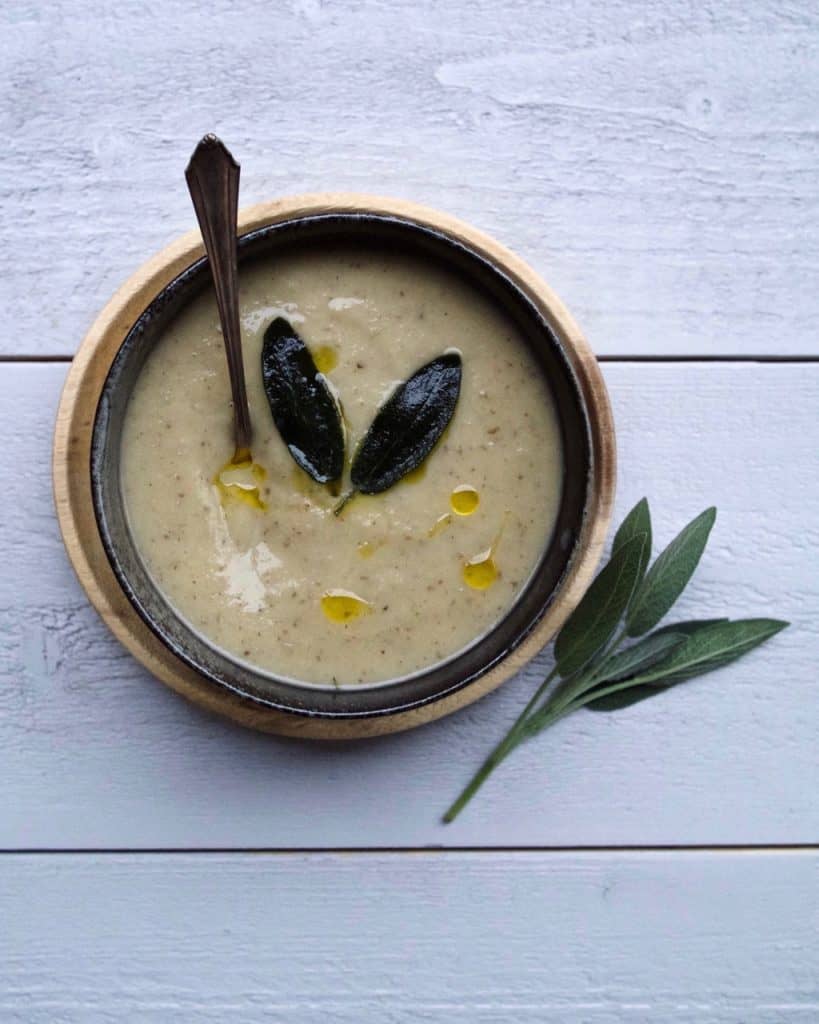
There’s probably nothing more common to make with Jerusalem artichokes (or “sunchokes”, as they’re also called) than soup, and there’s a plethora of recipes available just a quick google search away. Nevertheless, we wanted to share our own version – or actually versions, because it seems we really can’t choose a favorite here! Anyway, let’s start from the beginning. Jerusalem artichokes are those funny looking tubers you’ll find in just about any grocery store – they’re starchy, just like potatoes, but the nutty, almost sweet flavor is not like that of any other root vegetable. They’re glorious just roasted in the oven, or sliced thin and baked into flavor bursting chips (a very sophisticated snack to welcome your dinner guests with, if we may humbly suggest so). And, of course, they’re fantastic in soup. Before we lose ourselves completely in soup galore though, a little heads up: Jerusalem artichokes contain inulin, which is a more or less indigestible form of carbohydrates that can cause… a touch of bloating. Now, the reaction is very individual – those with IBS might want to be careful with their consumption, while those with a healthy gut flora can munch away and be fine. See, inulin acts as a food source for your beneficial gut bacteria (hence the increased activity), and can therefore actually promote a happy bowel environment. And you know what? You can easily build up your tolerance for inulin, so a small bowl of soup today could mean a much bigger next week. Point is, don’t give up on Jerusalem artichokes. They’re way too delicious to be given the cold shoulder.
Here, we’ve used both roasted and boiled tubers – it makes for the best flavor (in our opinion) and is totally worth the extra work. In order to make the soup decadent and creamy without using actual heavy cream, we blended cannellini and oat milk until silky smooth and stirred that into the puréed ‘chokes. Opting out of heavy cream here only means going more eco-friendly and upping the nutritious value of the meal – not that we’re afraid of fat. Remember how we couldn’t pick a favorite though? The other version that we just LOVE comes with coconut milk – if you’re intrigued by this concept, just substitute 2/3 cup (1.5 dl) coconut milk for the oat milk/bean combination, and use white wine vinegar instead of balsamic. If you end up trying both – or either – let us know! Oh and while the crispy sage looks unbelievably pretty, it’s not all for show. They’re delicious, and the contrast in texture does elevate the dish a little further. That’s all! Happy soup Thursday!
For recipe in English, click here: Jerusalem Artichoke Soup
6-8 portioner
1200 gram jordärtskockor
1 st. purjolök (ca. 500-600 gram)
4 st. vitlöksklyftor
8-10 st. timjankvistar
2 msk buljongpulver
4 dl havremjölk
2.5 dl cannellinibönor
1.5 tsk balsamvinäger
Olivolja
25-30 st. salviablad (ca. 4 st. per person)
Salt och svartpeppar
Sätt ugnen på 200°C. Skrubba rent jordärtskockorna och kvarta dem sedan. Placera hälften i en ugnsform och vänd i 1 msk olivolja, 0.5 tsk salt och en nypa svartpeppar (ett par varv med kvarnen). Ugnsrosta sedan i ca. 25 min (vänd runt dem efter halva tiden) eller tills dess de är mjuka hela vägen igenom. Under tiden, halvera purjolöken på längden och skär den sedan tunt. Hacka vitlöken. I en stor kastrull eller gryta, fräs purjolöken i ca. 2 msk olivolja på medelvärme, i ungefär 5-10 min. Se till att röra runt ofta så att det inte bränner fast. Blanda ner vitlöken samt resterande jordärtskockor och fräs vidare i ett par minuter till. Häll sedan på 1.6 liter vatten, pudra ner buljongpulvret och lägg i timjankvistarna (helst ihopknutna med kökssnöre, så blir de lättare att fiska upp senare). Låt koka upp och sjud sedan på låg värme i ca. 20 min, eller tills kockorna är mjuka. Under tiden, mixa havremjölk och bönor silkesslätt, antingen i matberedare eller med stavmixer. Ställ åt sidan.
När jordärtskockorna i buljongen är mjuka, stäng av värmen. Tillsätt de ugnsrostade, fiska upp timjanknytet och mixa sedan soppan slät. Häll på bön- och havremjölksblandningen och mixa ännu lite till. Rör ner balsamvinäger och smaka av med salt (om buljongen du använder är salt är det troligt att du inte behöver tillsätta något mer). Hetta sedan upp olivolja – så att det täcker botten – i en liten stekpanna, och lägg sedan i salviabladen. Låt ”steka” 1-2 min per sida och placera sedan att torka en aning på hushållspapper. Servera soppan i djupa skålar, med ett par salviablad uppepå. Smaklig måltid!